
Every professional services firm runs the same chain. A deal is won, a contract is signed, a project is opened, people are allocated, hours are logged, and an invoice goes out. Six steps, in the same order, every time.
The chain itself is not the problem. The joints are. At each of the six handoffs, information has to move from one person and one tool to another, and in most firms it moves by copy and paste, by email, or by memory. Every joint is a place where data is re-keyed, context is dropped, and a problem gets discovered a few weeks later than it needed to be.
Handoff 1: won deal to contract
Sales marks the opportunity Closed Won. Someone drafts the Statement of Work, usually from the last similar SoW, and the negotiated specifics get retyped into it.
What breaks: the SoW says something slightly different from what was sold. A rate that moved late in the negotiation, a start date that shifted, an exclusion the client asked for. Nobody notices until delivery hits it.
What good looks like: the contract is created from the deal record, carrying the account, the negotiated value, the currency, and the billing type across without retyping. The Statement of Work stays linked to the deal it came from, so the two never drift apart.
Handoff 2: contract to project
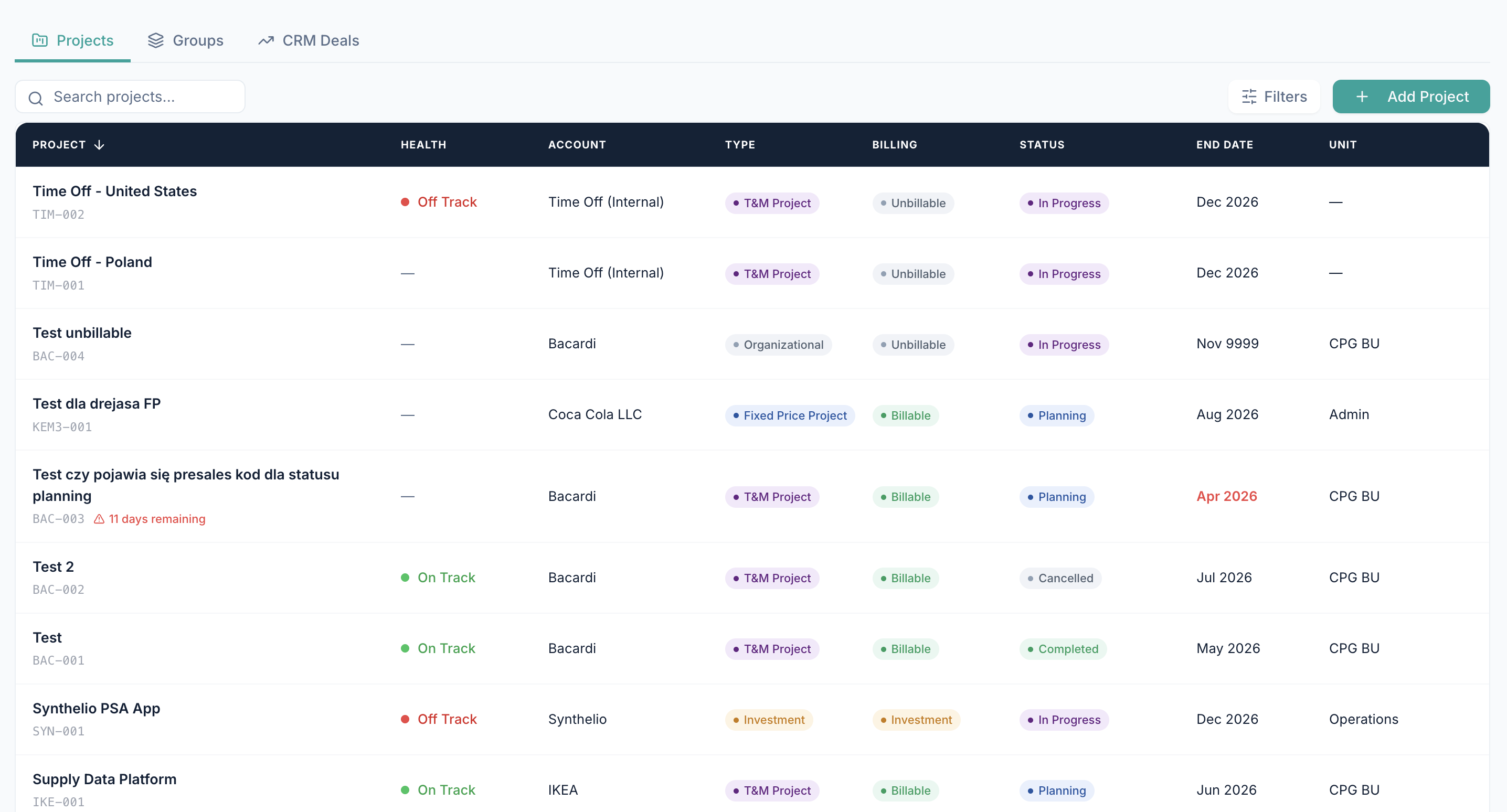
The signed SoW becomes a project. Someone opens a project code, sets up a folder, adds a row to the master tracker, and tells the PMO.
What breaks: the project exists but nothing structural came with it. The rate card, the billing milestones, the PO reference, and the end date all stay in the PDF. The project record holds a name and a client, which is enough for admin and useless for financial control.
What good looks like: the project inherits its commercial terms as data. When it exists, it already knows its rates, its billing type, its milestones, and what it is worth. Everything downstream can then be calculated instead of maintained.
Handoff 3: project to allocation
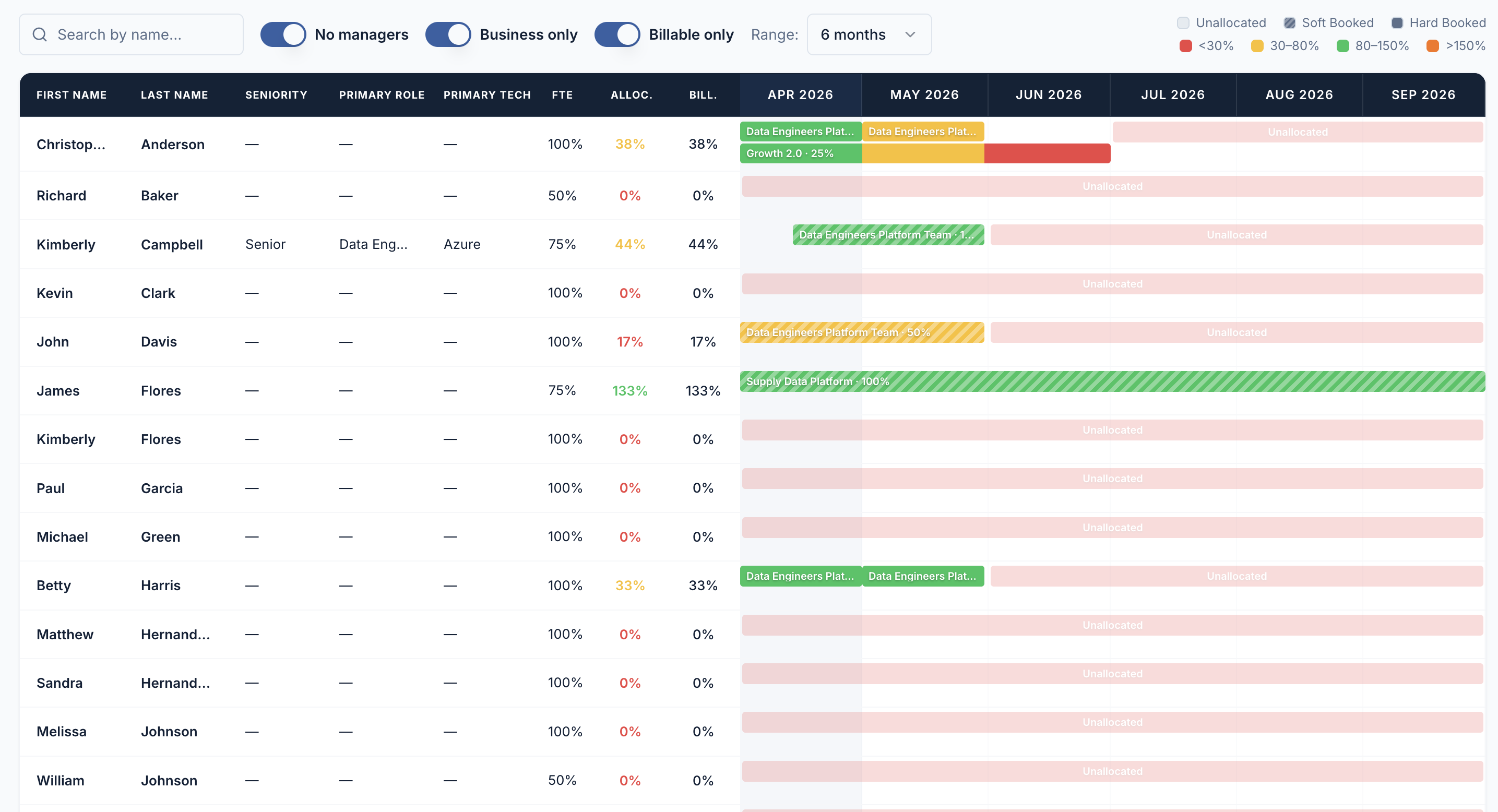
The delivery lead works out who is available and assigns people, typically in a spreadsheet that is separate from wherever the project was just created.
What breaks: the resource plan and the project list are now two systems that must be kept in agreement by hand. Within a month they disagree. Someone is allocated to a project that ended, a project is running with nobody formally on it, and the firm's utilization number is quietly wrong.
What good looks like: allocations sit on the project record, so the same action that staffs someone also updates capacity, forward utilization, and expected cost. There is nothing to reconcile because there is only one dataset.
Handoff 4: allocation to timesheet
People log their hours. In most firms this means finding the right project code in a list of two hundred, several days after the work happened.
What breaks: the hardest joint in the chain, and the one every firm underestimates. Time gets logged late, against roughly the right code, in round numbers. Every downstream figure, margin, utilization, realization, invoices, inherits that imprecision.
What good looks like: the timesheet is built from the allocation. The projects a person is booked to are already there, the hours can be distributed across them proportionally, last week's structure can be copied, and time already recorded in Jira is pulled in rather than entered twice. Compliance follows convenience, never reminders.
Handoff 5: timesheet to invoice
Approved hours become invoice lines. In a large number of firms this is a monthly export to a spreadsheet, a manual application of rates, and a re-entry into the accounting system.
What breaks: it is slow, it happens once a month, and it is where rate errors and missed hours enter the process. It is also why nobody can tell you today what this month's invoice will be.
What good looks like: approved hours multiplied by the contracted rate become invoice lines automatically, in the contract currency, checked against PO coverage before anything is sent. From there the invoice syncs to your accounting system rather than being retyped into it.
Handoff 6: invoice to insight
The last handoff is the one most firms never complete. The invoice is issued, and the question of whether the engagement was actually profitable goes to a separate reporting exercise, weeks later, in a different tool.
What breaks: by the time margin is known, the engagement is over. The lesson arrives too late to change the delivery and too vaguely to change the next bid.
What good looks like: margin is a live consequence of the same data, visible during delivery and rolling up across accounts, units, and the firm without a reporting cycle.
Counting the cost of the joints
Individually none of these is dramatic. Together they explain most of what services leaders complain about. The re-keying itself is the smallest cost. The real costs are the delay before a problem becomes visible, the disagreement between two systems that should hold the same number, and the reporting that is always describing a period that has already ended.
A useful exercise: for each of the six handoffs in your own firm, write down who does it, in which tool, and how long after the trigger. Firms doing this for the first time usually find at least two joints where the answer is a person, a spreadsheet, and a month.
Have you outgrown the spreadsheet
Spreadsheets are genuinely fine for a while. The honest signals that a firm has passed that point are specific:
- Two people maintain overlapping versions of the resourcing plan
- Nobody can answer "what is our current utilization" without building something first
- Project margin is only knowable after month-end close
- Invoicing takes more than a day of someone's month
- The same client data is typed into three systems
- A person leaving would take real operational knowledge with them
Three or more of those is the point at which the spreadsheet is no longer cheaper than a system. It is just cheaper on the invoice.
One dataset, six joints removed
Professional services automation is not a category of software so much as a decision to hold this entire chain in one dataset. A won deal becomes a contract, a contract becomes a project, a project becomes allocations, allocations become timesheets, timesheets become invoices, and margin is the arithmetic that falls out of it.
Synthelio connects deals, contracts, resourcing, time, and billing in a single system for IT services firms, consultancies, and agencies, with nothing re-keyed between them. Start free with unlimited time tracking for your whole team, plus your first client engagement with every feature unlocked.